

I just launched Originals, a Substack about the humans building the future of civilization. This is the first issue.

Science just discovered the antifreeze that makes reversible human cryonic freezing possible. The only problem is that it kills the patient. Dr. Alex Mathiasen, PhD, a 32-year-old mathematician with no lab, no chemists, an Oxford physicist co-founder and a stack of GPUs is betting his career that he can compute the poison out of existence using quantum simulation. Cryonic toxicity is the last wall. And his parents are sixty.

Alex Mathiasen was seven the first time he understood that everyone he loved would die. He sat on the floor and cried, and his mother gave him the only comfort any parent has for this particular arithmetic: don’t think about it.
He ignored her.
He is thirty-two now, a Danish mathematician with a PhD in algorithmic optimization. For his entire adult life he has aimed that one skill at a single target, and it has carried him here — to a company called Vitrify Labs, and a proposition that sounds, on first hearing, insane.
Scale beats clever. Even in biology.
Mathiasen wants to build a pause button for human biology. Stripped to the studs, the idea runs like this. Take a person who has run out of time — late-stage cancer, an organ failing, the disease that took his grandmother — and freeze them in suspended animation, like Han Solo in Star Wars. Hold them there, unchanging, at 196 degrees below zero, for as long as it takes medicine to invent the cure they need. Then warm them up. The same person, resumed.
He does not think this is science fiction. He thinks it is an engineering problem the world has been too unimaginative to take seriously — and that the last obstacle between us and that pause button is a poison he can compute his way around.
Scale Is All You Need
You would be within your rights to stop reading. The dream of freezing the body and waking it later has a long and faintly disreputable history — frozen heads, desert dewars, promises that conveniently cannot be checked for a century. But Mathiasen is not a man you wave off.
Strip away the titles and the whole of him is a gift for the shortcut. During his PhD at Aarhus University he built a parallel algorithm for one of the slowest operations in machine learning — decomposing a dense matrix — and made it run, in the best case, 27.1x faster than the standard method. The paper went to NeurIPS, the field’s most selective conference, in 2020. Then, at the chip company Graphcore – an AI chip company bought by Softbank for $600M to compete with Cerebras and Groq – he ran into the lesson that now drives his company: in machine learning, scale wins.
Big Pharma buys drugs, not platforms.
Feed a simple model a mountain of data and it beats a clever model fed a molehill. In biology the mountain doesn’t exist, because nature is expensive to measure — so he built it, simulating molecules on Graphcore’s chips until he had a dataset of 1B examples. The previous record was 20M. It had taken two years on conventional supercomputers; he produced 50x more in days.
That is the thesis: scale beats clever, even in biology.
And here is the tell. He could have sold that dataset as the definitive tool for chemical machine learning. Instead he published its flaws — in his own hand, in the documentation, he warned other researchers that his shortcuts had introduced errors and that they must not use his data to rank their models. In a field full of people overselling, he undersold his own billion-molecule monument. Hold onto that. It is rarer than the math.
Elegant math wins academic prizes. Functional math ships products. Mathiasen builds functional math.
Why Not Just Start a Company?
During a seven-month stint at Charm Therapeutics in London, he learned the broken economics of drug discovery startups up close: Big Pharma buys drugs, not platforms. So the bio teams built narrow specialists — one deep-learning model in service of one drug against one cancer — not GPTs, not the general-purpose transformers powering Anthropic and OpenAI.
The bio people were ignoring the scaling laws.
Build a GPT that understood biology the way GPT-5 understands language, and drug discovery becomes a query against it. The only open question was the cost of the data, which — unlike writing on the internet — does not yet exist in digitized form.
Cryo scaling is beating Moore’s Law. 100x in 3 years.
But every dollar at a biotech chases the next molecule, because the next molecule is what gets the company acquired. A biology GPT would cost at least as much as starting two more drug programs — so nobody starts one. Single molecules are the business model.
“There’s a 100% chance it works,” laughed Etminan. “It’s just we can’t tell you how much it’s going to cost. It could cost a million bucks. It could cost a trillion.”
Mathiasen felt stuck.
Then a venture capitalist asked him the question founders spend their lives waiting for — why don’t you just start your own company?
Thus was born Vitrify Labs, a company devoted to longevity without drug discovery.
Han Solo in Carbonite
His timing is not an accident. The ground shifted under this whole field in three years, and almost none of the shifting was his.
The trouble has always been one brutal fact of chemistry. Water wants to be ice. Cool it and the molecules snap into rigid six-sided crystals — Mathiasen calls it water’s “hexagon fetish” — and the crystals shred cell membranes like microscopic shrapnel.
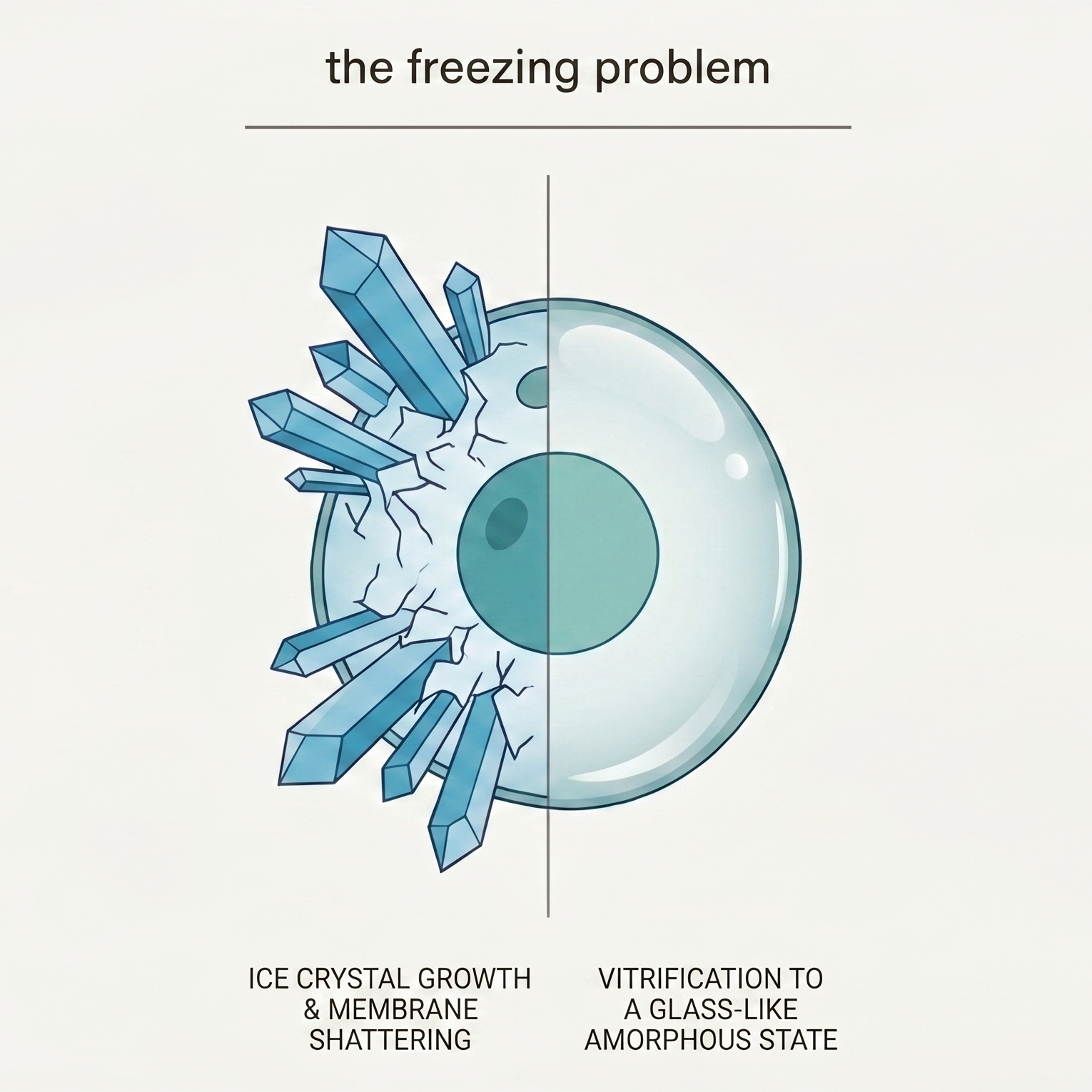
The escape is vitrification: replace enough of the water with antifreeze, cool it fast enough, and the liquid never crystallizes. It goes solid the way glass does, a frozen liquid with nowhere to put its hexagons. At the atomic level, nothing moves. Cellular metabolism stops. It is, he says, “time dilation, but at the level of molecular diffusion.”
Or, put more bluntly: Han Solo in carbonite.
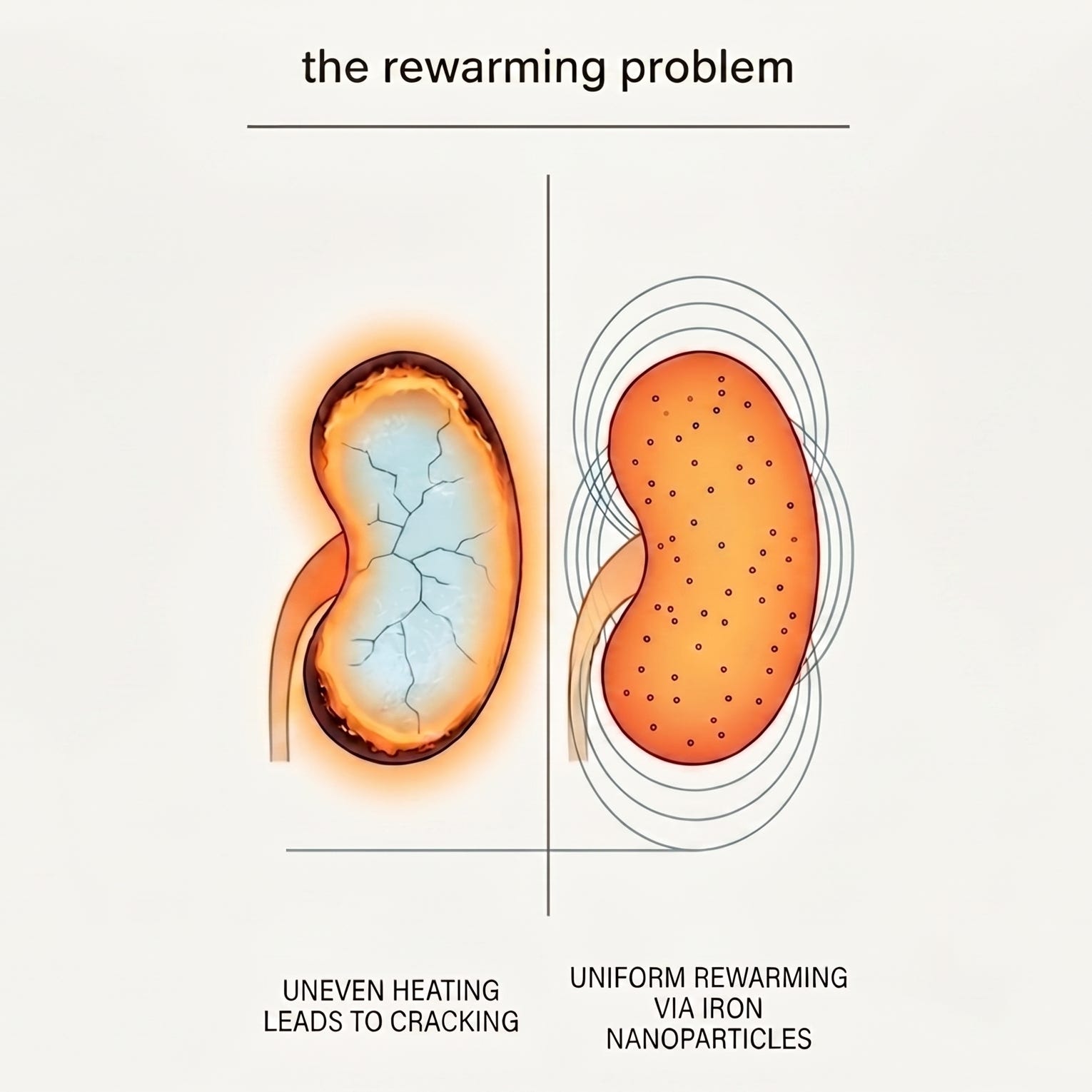
A single cell is easy — it is how IVF clinics bank embryos. The problem was always size. Bigger things hold more heat, and to rewarm them without cracking you must heat the whole mass at once, evenly, fast, which you cannot, because heat travels from the outside in. Mathiasen calls it the burrito problem: scorched at the edges, frozen in the middle. The fix is iron. Perfuse an organ with magnetic nanoparticles before cooling; when it is time to thaw, drop it into an alternating magnetic field and the particles vibrate, heating the tissue uniformly from within.
From Science Fiction to the Journal Nature
Magnetic nanoparticle perfusion has unlocked an epic run of scientific progress. Now cryogenic scaling is beating Moore’s Law. 100x in 3 years.
In 2023, in Nature Communications, a group at the University of Minnesota vitrified a rat kidney, rewarmed it, transplanted it, and kept the animal alive.
By November 2025, in the same journal, a team had pushed vitrification to liter volumes — organs the size of a pig’s liver.
In March 2026, in PNAS, a German neurologist named, almost unbelievably, Alexander German recovered a vitrified mouse hippocampus from 196 below zero with its long-term potentiation — the cellular signature of memory — substantially intact. The machinery of remembering survived the glass. Researchers are now showing pig kidneys at conferences.
Three dominoes in three years. And every one of those papers, read past the headline, names the same surviving villain. It is not the cold that does the damage now, nor the rewarming. It is the antifreeze itself.
The Poisonous Miracle of Human Antifreeze
This is where Mathiasen comes in, and what Vitrify Labs is actually building underneath the talk of solving death: a better antifreeze. He calls it the juice. The juice in use today is a brew of industrial solvents — dimethyl sulfoxide, ethylene glycol, formamide — pumped into a body to replace roughly sixty percent of its water.
It works.
He does chemistry inside an Nvidia GPU.
It also poisons the tissue, and the longer the molecules sit there waiting to diffuse, the more they poison it. The whole game is to find a cocktail that blocks ice, slips through cell membranes, and doesn’t kill the patient — and nobody has, because the space of possible molecules is effectively infinite and a wet lab tests a handful at a time.
An infinite search space; a toxic compromise nobody has optimized. It is, structurally, the problem Mathiasen has spent his career solving. He is not a chemist mixing vials at a black epoxy bench. He does chemistry inside an Nvidia GPU.
Simulating Quantum Physics with GPUs
The tools that make this thinkable are absurdly small. There are neural networks — on the order of 27M parameters, a rounding error beside the trillion-parameter LLMs pedaled by Anthropic and OpenAI — that have effectively learned quantum mechanics, simulating reality atom by atom in steps of a single femtosecond, one millionth of one billionth of a second.
The catch is speed: such a simulation has meant months of a postdoc’s coding and weeks of supercomputer time. Mathiasen sets autonomous AI agents to write the code in an hour and runs it in a day, hunting across millions of candidate molecules for the one that permeates the membrane, blocks the ice, and leaves the cell unharmed.
When he finds it, he will farm the physical synthesis out to contract labs, test it on animal tissue, and scale. In the world of synthetic biology, they call this approach, “Lab in the Loop.”
Two of the three properties he needs — blocks ice, crosses the membrane — are physics, the thing he taught a computer to simulate at Graphcore.
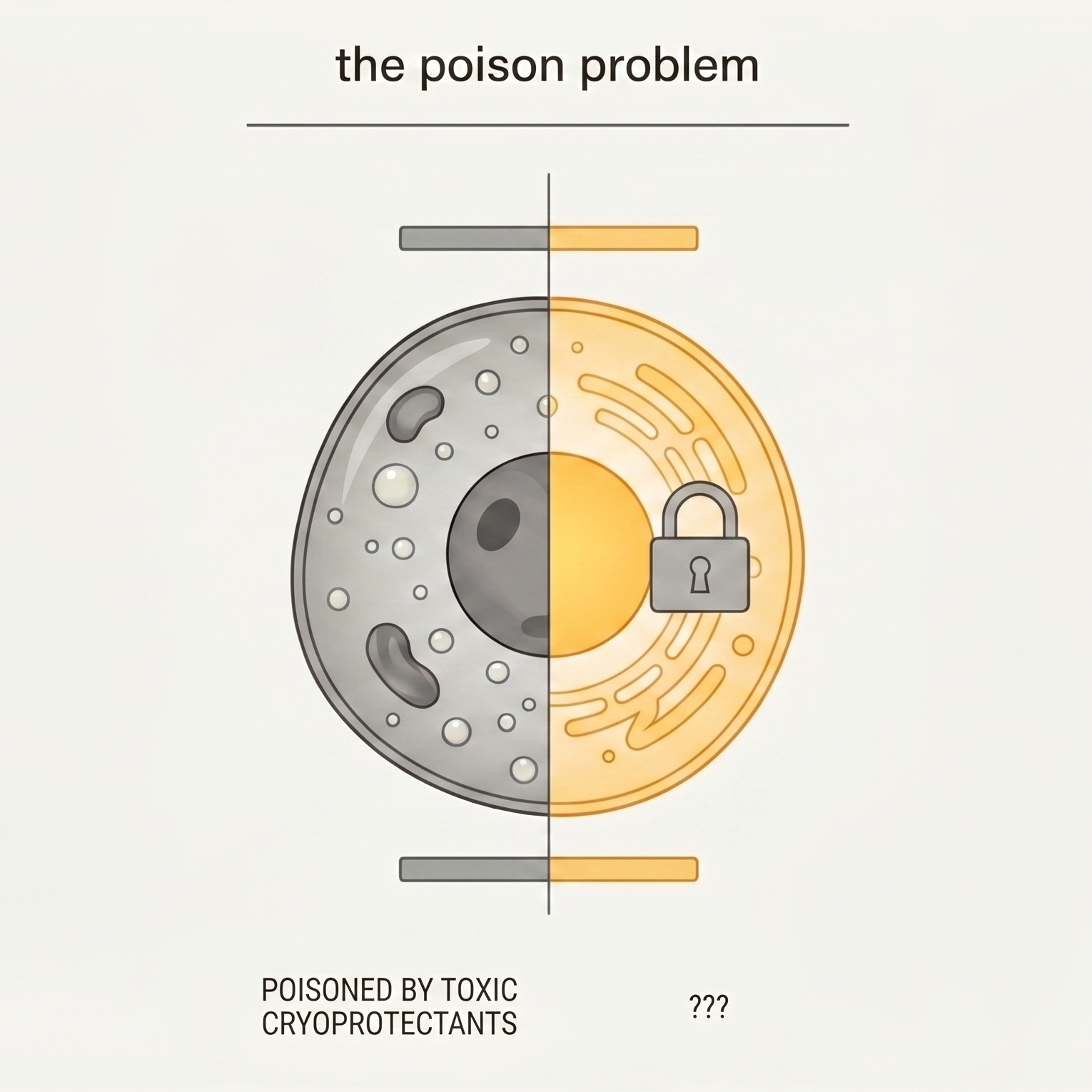
The third, toxicity, is the unknown, and he is unusually frank about it. He thinks the simulation can predict it. He also says he has reasons to believe the problem is hard, and then, in the same breath, that he isn’t sure he trusts his own reasons. That is the bet, without varnish: that the poison can be predicted in a computer before it is ever mixed in glass.
The Barbecue Hiring Plan
Set against the ambition, the company is almost comically small. Two people. A registered firm in Cambridge. A stack of validated credentials, a thesis that lands squarely on the open problem of a suddenly hot field, and no announced funding, no laboratory of their own. The hiring plan, when I asked, was a barbecue: Mathiasen recently threw one for friends from his old companies and figures the excited ones are the first recruits. They debate whether they want a one-pizza team or a two-pizza team. Their titles exist as a joke. “Tom executes,” Mathiasen says, “and I tech.”
Tom Etminan is the other half of the bet, and a corrective to the idea that this is one man’s death wish.
They want this to become a medical procedure rather than “a crazy alternative funeral arrangement.”
Tom is a Oxford-trained physicist whose last company, Metavoice, pioneered real-time voice cloning with small, fast on-device models.
His engine isn’t terror but impatience — a “time anxiety,” he calls it, too many things he wants to do and too few years to do them. He won’t paraglide anymore, because the cost of missing the future, if the future is as good as he thinks, is too high to gamble on a hobby. And he is not ballast: after Mathiasen spent weeks wringing a 4x speedup out of one of their models, Etminan came along with AI coding agents and pulled another 2x out of code his partner had already called finished.
The Master Plan
The arithmetic of the company itself is small enough to check. They think $10M, five engineers and a medium-sized GPU cluster can definitely answer the first question: whether the toxicity can be predicted in a computer, and a better juice found inside it.
“$1.5M is enough to de-risk 80/20,” says Mathiasen. “$10M gets us there faster and gives us maybe 95/5.”
After that, a staircase, climbed a rung at a time.
Vitrify’s 15-Year Product Roadmap
Incrementally better cryo-juice.
Juice that’s a little less poisonous than today’s — sold to IVF clinics that bank embryos and researchers who freeze cell lines.Larger tissue samples.
Skin grafts, corneas and heart valves.Whole human organs.
The prize is transplantation itself: the kidneys and livers that now get a few hours in a cooler strapped into the back of an ambulance, turned into a planned procedure performed on the surgeon’s calendar.Whole mice.
Whole pets.
Whole humans.
Each rung pays for the next. Each rung also tells them whether to keep climbing — or to stop.
A Medical Procedure, Not a Crazy Alternative to a Funeral
Mathiasen and Etminan work hard to stand apart from the cryonics tradition they so easily get mistaken for. They want to build upward from the provable — an organ, then a mouse, then perhaps a pet — verifying each step before the next. They want this to become, in Etminan’s phrase, a medical procedure rather than “a crazy alternative funeral arrangement”: the thing a hospital does when it has run out of options and would rather press pause than call the time of death.
Two facts sit beside each other here, and both are true. The science is real, it is moving, and the people moving it publish in the best journals on Earth. And the problem Vitrify exists to solve — the toxicity — is unsolved, by them and by everyone, and the researchers closest to the work are the first to say how far the road still runs.
Alexander German, whose mouse brain made the headlines, was blunt that better vitrification solutions — better juice — will be needed before any of this reaches a human organ. Which is either a warning or a job description, depending on where you sit. Others noted that even his success rate on a whole brain was low, and that cracking and heat transfer grow worse, not better, as things scale.
Originals is proudly sponsored by

Cleaner financings and secondaries for private companies.
Learn more here.
That leaves Mathiasen at the edge of a thing that might be visionary and might be naive, with no instrument that can tell him which — an uncomfortable place for a man whose entire profession is measurement.
The commercial logic on the way there is sound enough. Better juice means more viable eggs banked per IVF cycle, sparing women repeated rounds of hormones for worse odds than they deserve. It means organs that survive longer than the few hours they now get in a cooler strapped into an ambulance, turning transplantation from a frantic race into a planned procedure. Large, real markets — enough to fund the climb.
Life Saver… or Lifestyle Choice?
But Mathiasen is not doing this to optimize IVF.
What he is selling, if it ever exists, is consent: the option, for the patient who has run out of time, to wait in glass until medicine catches up.
People will just freeze themselves because they’re annoyed.
It would also, he and Etminan freely admit, get strange. With a real pause button, people wouldn’t reach for it only when they were dying. They’d reach for it when they were bored.
“Imagine a world where you have perfectly reversible freezing,” Etminan says. “People will just freeze themselves because they’re annoyed. Say a war’s been going on for, like, twenty years. People will say, ‘I’m so sick of this,’ and freeze themselves with a note that says: ‘Wake me up when the war’s finished.’”
What Mathiasen cannot do is make it come faster. His parents are sixty. The juice that might save them does not exist, and the man whose whole gift is making slow things fast has no shortcut for this one — no parallel algorithm, no chip to throw at it. He is betting his career that fifteen years will be soon enough. It is the one calculation he cannot check.
All images generated by AI. Portrait rendered from reference photographs of Alex Mathiasen. Not a photograph. Read more about How I Work.
You'll excuse me if all I see is a second iteration of the Tower of Babel
Sounds all too familiar