The following is an excerpt, lightly adapted, from A Deliberately Inefficient Machine, my latest piece in Originals — a profile of Dylan Morris, a thirty-year-old betting his company against General Electric to break America’s five-year power backlog. The turbine is the story. But buried in the middle was an argument bigger than any one company — the one this newsletter is named after.
The God Input
Dylan Morris found the secret of the American economy inside a textile mill he was trying to buy. Doing diligence on the factory’s books, he saw that 30% of its cost of goods was electricity. Not labor. Not fiber. Power. He tried everything to beat it — modeled rooftop solar, ran the offsets, called a nuclear startup: “Dude, when can I get a reactor? I need a megawatt.” There wasn’t one. There wasn’t anything.
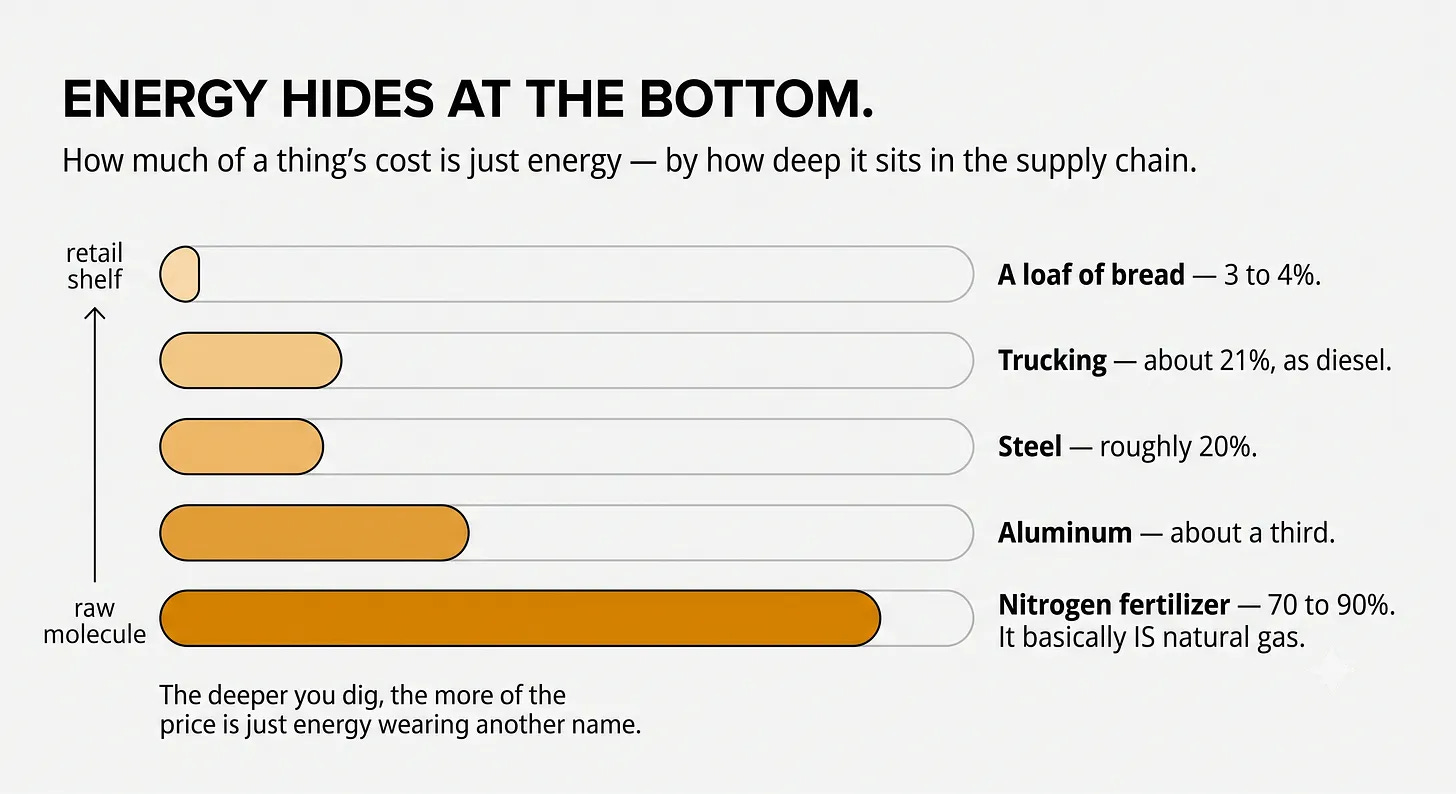
Energy is like that: buried in everything else, unevenly. Take fertilizer. Natural gas is 70 to 90% of the cost of making the nitrogen kind — not the fuel that runs the plant, the actual feedstock, the molecule itself. Fertilizer isn’t made with energy; it more or less is energy, pressed into a form roots can eat. When European gas prices spiked in 2022, the plants didn’t cut back. They switched off — 70% of the continent’s capacity, dark, because the product had become worth less than the gas it was made of.
Your material cost is somebody else’s energy cost, and theirs is somebody else’s below that, all the way down.
Now follow that fertilizer up into a two-dollar loaf of bread. The wheat it grew is about seven cents of the price. The farmer’s whole cut — fertilizer, diesel, seed, land — is 3 or 4%. The rest, the other dollar-ninety, is baking and packaging and trucking and shelf space and the lit, chilled store. Because your material cost is somebody else’s energy cost, and theirs is somebody else’s below that, all the way down — and at the bottom of that stack sits a molecule of natural gas.
Energy is 90% of the thing at the base and pennies of the thing on the shelf, hiding at every step inside a line that says “materials” or “freight.” It isn’t 6% of the economy. It’s the foundation of the economy, priced like a rounding error because we only meter it at the end.
Cheap Energy Is Cheap Everything
When energy stopped getting cheaper in 1979, America didn’t lose its industry at random. It lost it from the base of the gradient up — the smelters, the ammonia plants, the foundries, the things that were mostly congealed electricity. The bakeries stayed. We kept the part of the economy that barely uses energy and exported the part that’s made of it, and called the wreckage a transition to services. Morris’s textile mill, 30% electricity, wasn’t a weird outlier. It was a piece of the half that left.
It’s a fringe view. It might also be true — and if it’s true, you’d expect to see it on a map, in countries that bet opposite ways on the same input.
Germany decided, over two decades, that the mark of an advanced society was using less energy. It’s a rich country’s instinct, and a moral one: efficiency as virtue, restraint as progress. Then Russian gas vanished in 2022, and the industrial base cracked along its most energy-heavy seam — chemicals first, because chemicals are the most naked energy in solid form, and BASF, the largest chemical company on earth, began pulling production out of the country that invented the industry. German industrial output has now fallen four years running.
China decided the opposite, at a scale that’s hard to make an American reader feel. It is building thirty-some nuclear reactors at once, roughly half the world’s nuclear construction, at four to five years apiece — while also building the coal, the gas, the solar, the transmission, all of it, on the theory that a country’s ceiling is set by how much energy it can command.
One country treats energy as a sin to be managed. The other treats it as the substance the future is printed on. The thesis here — that energy is upstream of everything, that abundant power is a growing everything — isn’t new. It’s the operating assumption of the fastest-industrializing power in history, and the abandoned assumption of the country that used to hold the title.
Low Energy America
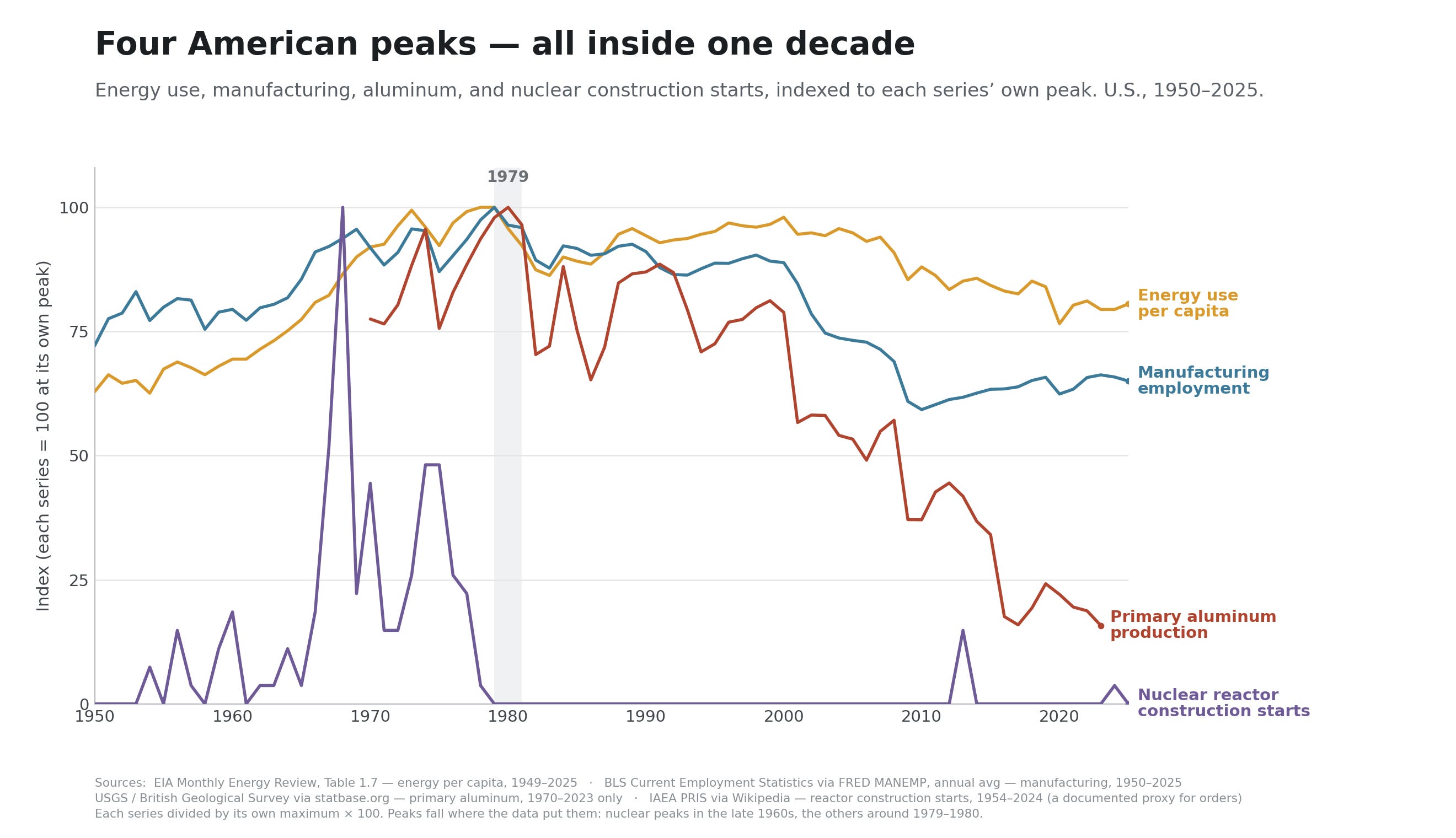
A whole cluster of things peaked at once and never recovered. Per-capita energy use topped out in 1979; the average American now runs on less energy than his grandfather did.
Manufacturing employment peaked in 1979. This is not a coincidence.
Primary aluminum peaked in 1980, and the last new American smelter opened that same year. Aluminum is the cleanest confession in the record — it’s congealed electricity, and when the power stopped getting cheaper it left. Four smelters survive, under 2% of world production. A competitive one needs power around $40 a megawatt-hour; AI companies are paying $115 and up and still can’t get enough. The industry America lost for want of $40 power is watching the new one pay triple, into a shortage.
What died in the 1970s wasn’t cheap energy — American power stayed cheap by world standards. What died was the expectation that it would keep getting cheaper, and expectation is what engineers build for. The technical culture flipped from make more to waste less.
The incumbents are still designing for 1979, and so is everyone around them: the utilities that won’t build ahead of demand, the bankers who remember the bond defaults, the regulators working in the shadow of Three Mile Island.
The Ghost of Jack Welch
Scarcity was the first doctrine. The second one has a name, and it explains why the wall stayed up even after the energy came back.
America has lost two-thirds of its foundries since 2000. A large power transformer — the machine every data center and every plant needs — now takes about 128 weeks to get, and roughly 80% of the big ones are imported; one American company, Cleveland-Cliffs, still makes the grain-oriented electrical steel inside them. The furnaces that melt aerospace superalloy are booked solid, and the next big American one doesn’t fire up until 2027. Run down the bill of materials of the American grid and every line reads the same: one supplier, two suppliers, an ocean away, sold out.
The forging press with the two-year waitlist is only the murder weapon. The doctrine that left a continental economy with a handful of presses has a name and a face.
Jack Welch took over GE in 1981 and became the most celebrated executive in America by discovering that Wall Street would pay you for subtraction. Close a plant, the stock rose. Shed a division, the stock rose. He cut more than a hundred thousand jobs in his first years — Neutron Jack, the buildings left standing, the people gone — and grew GE Capital until a company famous for building things made a startling share of its money as a bank. Fortune named him Manager of the Century.
And none of it was stupid; all of it worked. Every CEO in America studied the playbook because the playbook made shareholders rich. Heavy factories were liabilities. The smart money went asset-light: keep the brand, the IP, the lucrative service contracts; sell the foundry, offshore the forge, fire the mechanics. Each quarter was defensible. Wall Street applauded every one. The sum is a country that can design anything and manufacture almost nothing, on the most efficient and most brittle supply chain ever built.
When Morris calls GE “a technical manual company” — one that designs and certifies but no longer builds — he thinks he’s insulting a competitor. He’s describing the finish line of a forty-year doctrine, and the American economy. Welch died in March 2020; the next year his conglomerate announced it would split into three. GE Vernova — the turbine maker now selling waitlists into the 2030s — is a fragment of the ghost’s estate.
Locked Out of Its Own House
Then the AI boom hit, money arrived in quantities nobody had seen, and Silicon Valley discovered what had been optimized away. You can’t train a model if you can’t turn on the lights.
The trap is circular, which is what makes it systemic. Reindustrializing — now the stated ambition of both parties — needs cheap, abundant power, because energy is 10 to 40% of the cost of everything. But cheap, abundant power needs exactly the industries that left: the forges, foundries, castings, transformers, heavy steel.
Energy needs manufacturing; manufacturing needs energy; the country is locked out of its own house with the key inside. And it’s bigger than the AI story everyone’s telling. By Morris’s read, data centers were only about 30% of the net new power the grid added last year. The rest was factories, oil and gas, the grid itself — a whole economy trying to plug back in.
Read the full story: A Deliberately Inefficient Machine in Originals